Air Bike Before or After Lifting? What Each Placement Actually Does
Quick Answer: Use the air bike before lifting only as a short, easy warm-up - about 3 to 5 minutes at a conversational effort, no intervals. Hard air bike work belongs after lifting, as a finisher, because it fatigues the whole body including the grip and trunk that your lifts depend on. Doing intervals first reliably costs you 5 to 15 percent on your working sets.
An air bike is the most honest machine in the gym and the easiest to misplace in a session. Five minutes of it can prepare you perfectly or quietly ruin the next forty.

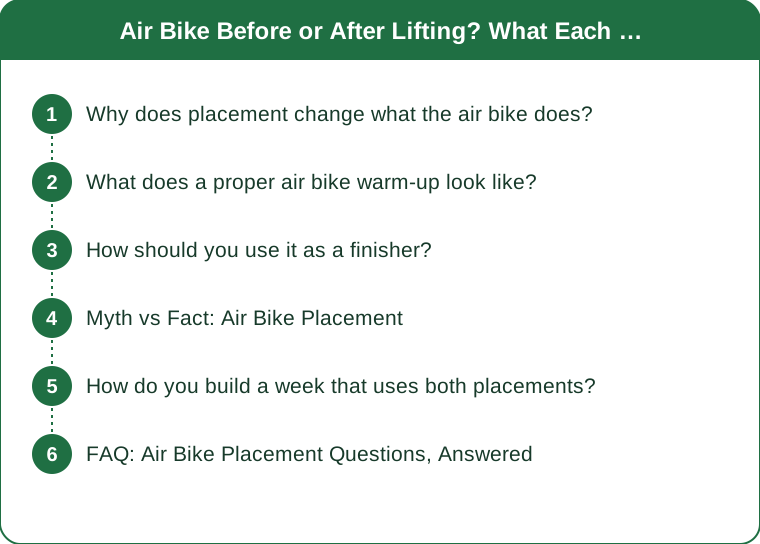
Why does placement change what the air bike does?
Because an air bike is unusually systemic. Most cardio machines load the legs and the cardiovascular system. An air bike loads legs, arms, shoulders, grip, and trunk simultaneously, and the resistance rises with your own effort so there is no ceiling to hide behind.
That combination makes it excellent as a conditioning tool and dangerous as a pre-lifting activity.
When you do hard intervals before lifting, three things happen:
- Peripheral fatigue in the same muscles you are about to load - quads, shoulders, and forearms
- Elevated breathing and heart rate that make a heavy set feel much harder than it is, so you cut reps or drop weight
- Reduced trunk stability, because bracing hard on a bike fatigues the same muscles that stabilise a squat or a deadlift
After lifting, all three of those become irrelevant or useful. The strength work is banked, and the fatigue you accumulate is exactly the training effect you wanted.
Same machine, same five minutes, opposite consequences. The mistake is treating the air bike as generic cardio that can go anywhere.
What does a proper air bike warm-up look like?
Short, easy, and boring. If it feels like a workout, it is in the wrong place.
The specification:
- 3 to 5 minutes total
- Effort you could hold a conversation at - roughly 4 out of 10
- No intervals, no sprints, no calorie targets
- Legs and arms both moving, which is the advantage over a treadmill here
What you are actually trying to achieve: raised muscle temperature, increased blood flow, joints moving through range, and a nervous system that has woken up. Temperature is the main variable, and it rises with just a few minutes of easy work.
Then leave the bike and do the specific part. General warm-up does not replace working up to your first heavy set. Two or three ramping sets of the actual lift do a job the bike cannot.
A sensible full sequence before a lower-body session:
- 4 minutes easy air bike
- 5 minutes of hip and ankle mobility and a couple of activation drills
- 3 ramping sets of the first lift, increasing to working weight
Total about twelve minutes, and the bike is the smallest part of it. The most common error is inflating the bike portion to fifteen minutes of moderate work, which is enough to blunt the first two working sets without adding any warm-up benefit.
How should you use it as a finisher?
This is where the air bike earns its reputation, and where structure matters because the machine will happily let you destroy yourself.
Option 1 - short intervals for conditioning. 20 seconds hard, 40 seconds easy, 8 to 10 rounds. Total about 10 minutes. Hard means genuinely hard but repeatable - if round eight is half the output of round one, you started too high.
Option 2 - longer intervals for work capacity. 60 seconds hard, 60 seconds easy, 6 to 8 rounds. More uncomfortable, more useful if your goal is sustaining effort rather than peak power.
Option 3 - steady state for recovery or base. 10 to 20 minutes at a conversational pace. Genuinely useful and massively underused, because it is not impressive.
Option 4 - the short sharp finish. 4 rounds of 30 seconds hard with 90 seconds easy. Six minutes total, and plenty on a day when the lifting was heavy.
How to place it: immediately after the lifting, or separated by a few minutes. Keep it to one hard finisher per session, twice a week at most, alongside easier steady work on other days. Air bike intervals produce a lot of fatigue per minute, and stacking them on top of a hard lifting programme is the fastest route to stalled lifts and dread.

Myth vs Fact: Air Bike Placement
Myth: Cardio before lifting is fine as long as it is short. Fact: Short and easy is fine - that is a warm-up. Short and hard is not, because intensity rather than duration drives the interference. A 90-second all-out sprint before squats costs you more than ten easy minutes would.
Myth: Doing cardio first burns more fat because you deplete glycogen. Fact: Total energy balance and total training quality decide body composition over weeks. Compromising your strength work to chase a substrate-use effect within a single session trades something real for something negligible.
Myth: The air bike is just a bike, so treat it like a stationary bike warm-up. Fact: A stationary bike loads the legs. An air bike loads arms, shoulders, grip, and trunk too, and the resistance scales with effort. It fatigues far more of what your lifts need.
Myth: A finisher needs to leave you on the floor to have worked. Fact: Repeatable output across rounds is the marker of useful conditioning. A session where round one is enormous and rounds two to eight collapse trained your ability to do one hard round, which you already had.
Myth: If I am doing upper body, air bike intervals first are harmless. Fact: The arms and grip work hard on an air bike. Sprint intervals before pull-ups or rows is one of the clearest ways to underperform, and people usually blame their back strength for it.
How do you build a week that uses both placements?
Give each placement a defined job and the conflicts disappear.
Monday - lower body strength. 4 minutes easy bike warm-up, lift, then 4 rounds of 30 seconds hard with 90 easy as a short finisher.
Tuesday - conditioning day. No lifting to protect. This is where the harder session goes: 10 rounds of 20 seconds hard, 40 easy, properly warmed up beforehand.
Thursday - upper body strength. 3 to 4 minutes easy bike, lift, and either no finisher or 10 minutes steady at a conversational pace.
Saturday - easy volume. 15 to 20 minutes steady or a walk. This is the session most people skip and it is doing a large share of the aerobic work.
The rules underneath it:
- Hard bike work never precedes lifting. Ever.
- One or two hard interval sessions a week, not four.
- Easy steady work can go anywhere, including after any session.
- If your lifts drop for two sessions in a row, cut the finisher before you cut anything else - conditioning is almost always the first thing to over-reach on, because it feels productive.
If you have a cardiovascular condition or have been advised to limit high-intensity effort, keep to the steady-state options and check with your doctor before adding intervals. This is general information, not medical advice.
FAQ: Air Bike Placement Questions, Answered
How long should I wait between lifting and a finisher?
Anything from immediately to ten minutes works. Longer gaps let you produce more on the bike, shorter gaps keep the session tight. Neither meaningfully changes the training effect.
Is an air bike warm-up enough on its own before squats?
No. It raises temperature and blood flow but does nothing to prepare the specific pattern or load. You still need ramping sets of the actual lift.
Can I use the air bike between lifting sets?
Easy pedalling between sets is fine and can keep you warm. Hard efforts between sets turn a strength session into a conditioning session and reduce the quality of both.
Should I count calories on the display?
The display is a useful consistency measure within one machine and a poor absolute figure. Compare your calories per interval to your own previous sessions on the same bike and ignore comparisons with anyone else’s numbers.
TL;DR:
- Before lifting: 3 to 5 minutes, conversational effort, no intervals
- After lifting: intervals or steady work, one hard finisher per session at most
- The air bike loads grip, shoulders, and trunk, so hard work first costs you 5 to 15 percent on lifts
- Repeatable output across rounds is the marker of a well-pitched finisher
- Cap hard interval days at two a week and let steady state do the rest
The air bike is not generic cardio you can drop anywhere in a session. It is a whole-body tool that either prepares you or competes with you, and the only thing deciding which is where you put it and how hard you go.
Keep Reading
This article is for general informational and styling purposes only. Fit, sizing, and product availability may vary.