Why the Air Bike Says 400 Calories and Your Watch Says 240
Quick Answer: The air bike console does not measure your calories - it converts fan work into a generic estimate using a fixed formula that assumes an average-sized rider and a fixed mechanical efficiency. Your watch estimates from heart rate and your entered body data, which is personalized but lags during intervals. On an air bike the console typically reads high for smaller riders, and the watch typically reads low during short high-intensity work. Use one consistently and treat it as a workload score, not a calorie count.
You finished ten hard intervals. The console said 412. The watch on your wrist said 238. Neither device is broken, and neither is telling you what you think it is.

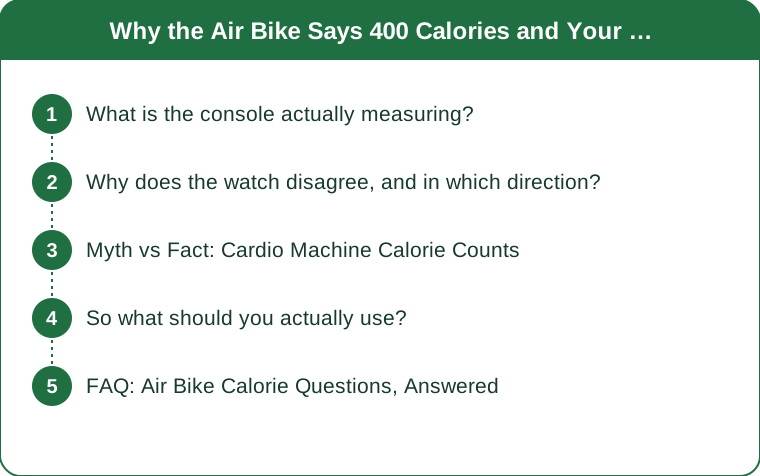
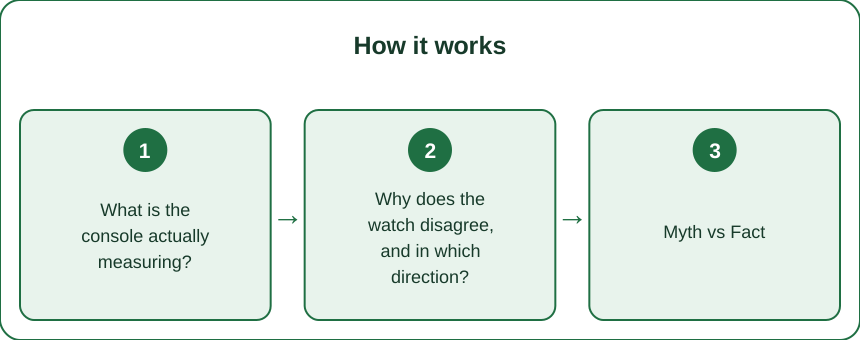
What is the console actually measuring?
Air resistance, converted through a fixed table. An air bike’s fan creates resistance proportional to roughly the cube of fan speed. The console measures how fast the fan is turning, calculates the mechanical work being done on it, and converts that number into calories using a preset formula.
The formula assumes a standard person. Most air bike consoles do not ask for your weight, age, or sex, and even where they do, the calorie figure is typically derived from fan work rather than from your data. That means the same displayed number appears for a 130-pound rider and a 210-pound rider producing identical fan speed - even though their actual metabolic cost differs substantially.
It also assumes a fixed efficiency. Turning metabolic energy into mechanical work runs at roughly 20 to 25 percent efficiency in trained cyclists, and the console’s conversion bakes in one value. Individual variation in efficiency is real and the console cannot see it.
The important consequence: for a smaller or lighter rider, the console generally overstates energy expenditure, sometimes substantially. For a larger rider working at the same fan speed, it may understate it.
What the console is genuinely good at: measuring external work with high consistency. If you produced 60 calories in a two-minute interval last week and 66 this week, you did roughly 10 percent more mechanical work. That comparison is valid and useful. The absolute number is the part that is not.
Why does the watch disagree, and in which direction?
It estimates from heart rate, which lags. Optical wrist sensors track heart rate, and algorithms convert heart rate plus your entered weight, age, and sex into an energy estimate. Heart rate is personalized, which is a genuine advantage - but it takes 30 to 60 seconds to respond to a change in effort.
In short intervals that lag is decisive. A 30-second all-out air bike sprint is largely over by the time heart rate reflects it, and heart rate then stays elevated during recovery when you are producing no work at all. The result is systematic underestimation during the work and overestimation during the rest, which do not fully cancel out.
Wrist sensors struggle specifically on air bikes. Gripping and pushing handles hard causes forearm muscle contraction and wrist movement that degrade optical signal quality. It is one of the harder environments for wrist-based heart rate, which is why readings sometimes drop implausibly mid-interval.
A chest strap fixes most of that. Electrical chest straps measure the heart’s actual signal rather than inferring it optically, and they respond faster and hold up far better under grip-heavy movement. If you care about heart rate data on this machine, the strap is the single highest-value change.
But heart-rate-derived calories have their own ceiling. Heart rate can be elevated by heat, dehydration, caffeine, poor sleep, and stress without any additional energy being expended. The watch cannot distinguish those from real work.

Myth vs Fact: Cardio Machine Calorie Counts
Myth: The machine with more sensors is more accurate. Fact: More inputs help with personalization but do not resolve the fundamental problem, which is that neither device measures energy expenditure. Actual measurement requires analyzing expired gases in a lab.
Myth: Cardio machines all overestimate. Fact: Direction depends on machine and user. Treadmills tend to overestimate for lighter users; air bikes overestimate for lighter riders and can underestimate for heavier ones. There is no single universal bias to correct for.
Myth: Air bike calories are the same as regular calories. Fact: Some machines display kilocalories and some effectively display a proprietary unit. Comparing an air bike calorie to a rower calorie to a food label calorie is comparing three different things that share a name.
Myth: If both devices agree, the number must be right. Fact: Two estimates converging can reflect similar assumptions rather than accuracy. Agreement is reassuring but not evidence.
Myth: You should eat back the calories the console shows. Fact: This is where the error actually costs something. Eating back an overestimated 400 when the real figure was 240 is a 160-calorie daily gap that quietly undoes a deficit. If you eat back exercise calories at all, use a conservative fraction.
Myth: The number does not matter at all. Fact: The absolute value is unreliable, but the relative value is genuinely useful. Consistent tracking on the same device reveals progress accurately even when every individual reading is wrong by the same margin.
So what should you actually use?
Pick one device and never mix them. Whichever you choose, the trend is meaningful and the absolute number is not. Comparing today’s console reading to last month’s console reading is valid. Comparing today’s console reading to last month’s watch reading is noise.
On an air bike, prefer calories per minute or total work over total calories. Most consoles show a rate. Sustaining 20 calories per minute for ten minutes is a specific, repeatable workload target that does not pretend to be a nutrition figure.
Better still, use time and distance. How many meters in 60 seconds, or how long to reach a set distance. These are direct measures of output with no conversion assumptions at all, and they are the metrics competitive testing actually uses.
Use RPE alongside the number. Rate perceived exertion 1 to 10 immediately after each interval. When the same console number starts arriving at a lower RPE, you have improved - and that is a more meaningful signal than either device produces alone.
For weight management, look at the scale and measurements over weeks. Energy balance is decided across weeks, and body weight trend plus waist measurement is a far better feedback loop than a per-session calorie estimate with a wide error bar.
And if you want the number to be closer, add a chest strap and enter accurate body data. It will still be an estimate, but a personalized one that responds quickly - which is about as good as it gets outside a metabolic cart.
FAQ: Air Bike Calorie Questions, Answered
Are air bike calorie counts accurate?
Not as absolute measures. The console converts fan work into calories using a fixed formula that generally assumes an average rider, so it tends to read high for lighter riders and can read low for heavier ones. It is reliable for comparing your own sessions to each other.
Why does my watch show fewer calories than the machine?
Watches estimate from heart rate, which lags 30 to 60 seconds behind changes in effort - so short hard intervals are largely finished before heart rate reflects them. The machine, meanwhile, measures fan work instantly and converts it with an assumption that often overstates it for smaller riders.
Which is more accurate for an air bike, the console or my watch?
A watch paired with a chest strap and accurate body data is usually closer for steady work because it is personalized. For short intervals, neither is good, and total work or distance is a better metric than either calorie figure.
Should I eat back the calories from my air bike workout?
Be cautious. If the console overstates by 40 percent, eating it all back can erase a deficit entirely. If you eat back exercise calories, use a conservative fraction and judge by body weight trend over several weeks rather than by any single session’s readout.
TL;DR:
- The console converts fan work into calories with a fixed formula and usually no body data, so it reads high for lighter riders.
- Your watch personalizes from heart rate but lags 30 to 60 seconds, which makes it systematically wrong during short intervals.
- Wrist optical sensors struggle on air bikes specifically because of hard gripping; a chest strap fixes most of that.
- Track calories per minute, distance, or time instead - these involve no conversion assumptions.
- Use one device consistently for trends, add RPE, and judge weight management on multi-week body weight trends rather than per-session estimates.
Both numbers are guesses. Pick one, stop comparing across devices, and use it as a workload score.
Keep Reading
This article is for general informational and styling purposes only. Fit, sizing, and product availability may vary.