How Long Should You Actually Rest Between Air Bike Intervals?
Quick Answer: For pure power intervals of 10 to 20 seconds, rest 2 to 4 minutes - a 1:9 to 1:12 work-to-rest ratio. For conditioning intervals of 30 to 60 seconds, rest 1 to 2 times the work duration. For capacity work of 2 to 5 minutes, rest roughly equal to the work. If your output drops more than about 10% from your first interval to your last, your rest is too short for the goal you picked.
Most people set air bike rest by feel, which means they rest until they stop feeling terrible. That produces a workout that’s uncomfortable in every direction and specific in none. The rest interval is doing more work than the work interval here.

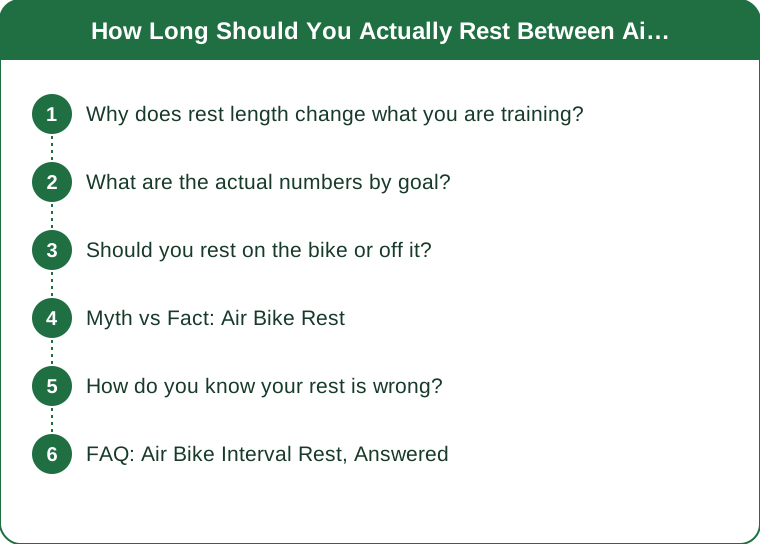
Why does rest length change what you are training?
Because different energy systems recover at wildly different rates, and the rest period selects which one you’re loading.
Phosphocreatine - the system powering all-out efforts under about 15 seconds - recovers substantially in around 3 minutes and near-fully by 5. Rest this long and each sprint is genuinely maximal. Cut the rest to 30 seconds and you’re no longer training peak power; you’re training your ability to produce mediocre power while tired. Both are valid. They’re different.
Glycolytic capacity - the burning, 30-to-90-second zone - is trained precisely by incomplete recovery. Here, short rest is the point.
Aerobic capacity sits at longer efforts with moderate rest, and the goal is total time spent near your ceiling.
The practical consequence: if you can’t say which of the three you’re training today, your rest interval is a guess, and the session will hedge across all three. Pick one per session.
What are the actual numbers by goal?
Here are the working ratios, with a sample session for each.
Peak power (1:9 to 1:12 work-to-rest)
- 10 seconds all-out, 2 minutes easy pedalling or off the bike
- 8 to 10 rounds
- Success looks like: your last round’s peak watts within 5% of your first. If it isn’t, add rest.
Conditioning and lactate tolerance (1:1 to 1:2)
- 40 seconds hard, 60 seconds easy
- 8 to 12 rounds
- This is the genuinely unpleasant one. Success looks like consistent calories per round, not maximum on round one.
Aerobic capacity (roughly 1:1)
- 3 minutes at a hard-but-sustainable effort, 3 minutes easy
- 4 to 6 rounds
- Success looks like holding the same pace on round 5 as round 1.
Threshold / steady (short rest or none)
- 8 to 12 minutes continuous at a conversational-but-working effort
- 2 to 3 rounds with 2 minutes between
The number that decides everything: your output on the final round compared to the first. Track calories or watts per interval and you have an objective read on whether the rest was right.
Should you rest on the bike or off it?
It changes the session more than people expect.
Easy pedalling (active recovery) keeps blood flowing, clears metabolites faster, and keeps your heart rate elevated. This is the better choice for conditioning and aerobic work, where you want incomplete recovery and continuous stimulus.
Standing or walking off the bike (passive recovery) allows fuller recovery of peak power output. For genuine sprint work where each effort must be maximal, get off the bike. Sitting fully still is fine here - the sensation of being unable to hold a conversation is not a sign you’ve done something wrong.
One caution on passive recovery after hard efforts: don’t sit down suddenly and stay still after an all-out sprint. Standing or slow walking for the first 30 seconds reduces the light-headedness that catches people after maximal air bike work.
A useful hybrid: 30 seconds of standing/walking, then easy pedalling for the remainder. You get the recovery benefit and avoid the blood-pooling wobble.

Myth vs Fact: Air Bike Rest
Myth: Shorter rest always means a better workout. Fact: Shorter rest means a different workout. Below a certain rest threshold, output falls so far that you’re accumulating fatigue without training any specific quality well.
Myth: You should rest until your heart rate drops to a set number. Fact: Heart rate recovery varies with heat, hydration, sleep, and caffeine, so a fixed target moves the session around unpredictably. Fixed clock times give you comparable sessions week to week. Heart rate is useful information; it’s a poor trigger.
Myth: If you can breathe normally, you rested too long. Fact: For sprint work, breathing normally again is exactly the point. Peak power requires it.
Myth: The air bike is too brutal to program precisely. Fact: It’s one of the easiest machines to program precisely, because it gives you an objective output number every interval. Most equipment doesn’t.
Myth: More rounds is always better. Fact: Once output drops meaningfully and stays down, additional rounds add fatigue cost without adding training benefit. Ending a session two rounds early on a bad day is a legitimate coaching decision, not quitting.
How do you know your rest is wrong?
Three signals, all readable during the session.
Signal 1: Your output falls off a cliff. If round 6 is 25% below round 1, the rest was too short for the intended quality. Either lengthen the rest or shorten the work.
Signal 2: Your form changes. Rounded lower back, knees falling in, shoulders climbing toward the ears. Fatigue-driven form change on an air bike is what turns a hard session into a sore lower back the next day. Form breakdown means rest, regardless of what the clock says.
Signal 3: Every round feels identical and easy. If you finish all rounds feeling you could double the session, either the rest is too long for the goal or the work effort isn’t high enough. For conditioning work, rounds should get progressively harder to hold.
The one-number habit: write down calories for round 1 and the final round, every session. Two numbers, ten seconds. Over a month you’ll see whether your conditioning is genuinely improving - the gap between them narrows as you get fitter, and that’s a cleaner progress signal than total calories.
FAQ: Air Bike Interval Rest, Answered
Does the air bike’s calorie counter mean anything?
As an absolute measure of energy burned, not much - the algorithms vary by machine and read high. As a relative measure within the same machine, it’s excellent, and that’s all you need for pacing intervals.
How many air bike sessions a week?
Two hard sessions per week is plenty for most people alongside other training. The air bike recruits nearly everything, so it costs more recovery than its duration suggests.
Should I use the same rest as I do for running intervals?
The ratios transfer, but the absolute recovery cost is higher on the air bike because the arms are involved. If in doubt, take the longer end of the range.
Is it normal to feel light-headed after an all-out effort?
Briefly, yes, and it’s the main reason to stay upright and moving for the first 30 seconds. Persistent light-headedness, chest discomfort, or dizziness that doesn’t settle is worth raising with a clinician rather than working through.
TL;DR:
- Sprints under 20 seconds need 2-4 minutes rest to stay maximal (1:9 to 1:12)
- Conditioning intervals of 30-60 seconds use 1:1 to 1:2 - incomplete recovery is the point
- Aerobic intervals of 2-5 minutes use roughly equal work and rest
- Active pedalling for conditioning, off the bike for true sprint work
- Track round 1 versus final round output - a drop over 10% means your rest is too short for the goal
Pick one quality per session and let the rest interval enforce it. The air bike hands you an objective number every round, which makes it one of the few machines where you can actually tell whether the plan is working.
Keep Reading
This article is for general informational and styling purposes only. Fit, sizing, and product availability may vary.