How to Program Air Bike Intervals Without Ruining Tomorrow's Leg Day
Quick Answer: Air bike intervals interfere with strength training mainly through leg fatigue, so place them either right after a lower body session or at least 24 hours before one - never the day before heavy squats. Two conditioning sessions a week is enough for most people: one short, hard session of 8 to 10 rounds of 15 seconds on with 45 seconds off, and one longer, easier session of 15 to 20 minutes at conversational effort. Progress by adding rounds before adding intensity.
The air bike will happily let you obliterate yourself in nine minutes. The problem shows up 36 hours later, when your squat feels like someone swapped the plates while you were not looking.

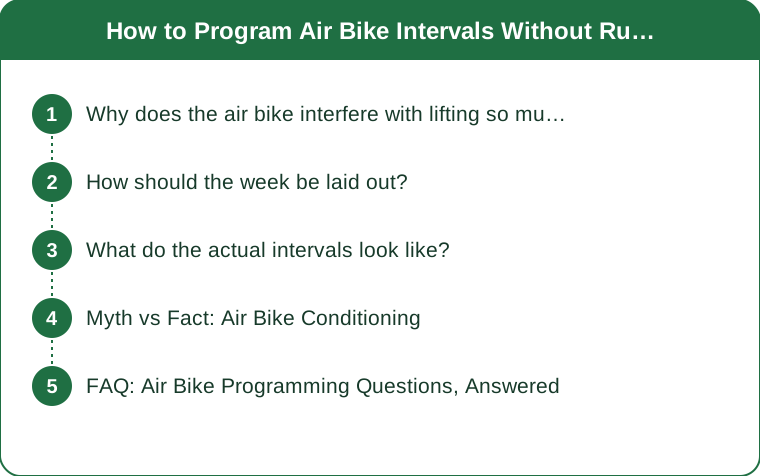
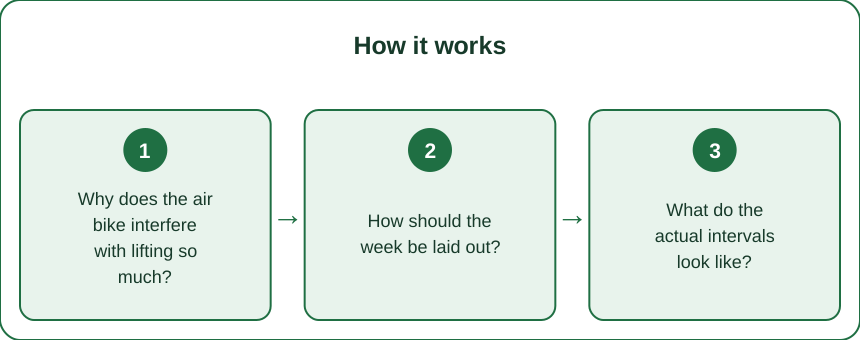
Why does the air bike interfere with lifting so much?
Because it loads the same muscles as your heaviest lower body work. The air bike is a full-body machine, but the legs supply most of the power. Hard intervals produce genuine muscular fatigue in the quads and hamstrings, not just cardiovascular fatigue - and that fatigue is what shows up under a loaded barbell the next day.
Fan resistance scales with your effort, which removes the natural ceiling. On a treadmill or a rower there is a practical limit to how hard you can go for 20 seconds. On an air bike, the harder you push, the harder it pushes back, so a maximal effort is genuinely maximal in a way most machines do not permit. This is why it is so effective and why it is so easy to overshoot.
The interference effect is real but frequently overstated. Concurrent training research generally finds that endurance work can blunt strength and power adaptations, with the effect largest when the modalities are similar, the volume is high, and the sessions are close together. Two well-placed sessions a week is not the scenario where interference dominates.
Proximity matters more than volume for most people. The same weekly conditioning volume can be nearly invisible or clearly damaging depending entirely on whether it sits the day before or the day after your heavy lower body work.
And the recovery cost is longer than the session feels. A truly maximal set of sprints can leave measurable leg fatigue for 24 to 48 hours, which is disproportionate to how short the workout was.
How should the week be laid out?
Rule one: never the day before heavy lower body work. This is the single scheduling decision that resolves most of the problem. Fatigued quads under a heavy squat is both a worse training stimulus and a worse-quality set.
Rule two: hard intervals go after a lower body session, not before. If you must put them on the same day, lift first and bike second. Doing it in the reverse order compromises the session that has more to gain from being fresh.
Rule three: keep the easy session genuinely easy. A workable week for someone lifting three or four times looks like: heavy lower body Monday, short hard intervals Monday afternoon or Tuesday, easy 15 to 20 minutes Thursday, heavy lower body Friday. Nothing hard lands the day before a squat.
Rule four: two conditioning sessions is enough to build meaningful capacity. More is not automatically better once you are also strength training, and the third session is usually the one that starts taxing the lifts.
Rule five: separate by six hours if you double up in a day. If your schedule forces a lift and a conditioning session onto the same day, spacing them meaningfully apart lets you eat, rehydrate, and produce a better second session.
And if you are training for a strength goal specifically, put the hard interval session on your upper body day instead. It preserves the legs almost entirely while still delivering the cardiovascular stimulus.

What do the actual intervals look like?
The short hard session: 15 seconds on, 45 seconds off, 8 to 10 rounds. Eight to ten minutes total. The work interval is a genuine hard effort - not maximal on the first round, or you will not survive to round six. Aim for the same output on round eight as on round one; a big drop-off means your first rounds were too aggressive.
The alternative: 30 seconds on, 90 seconds off, 6 rounds. Longer work intervals sit less comfortably and produce more leg fatigue, so use this one further from your lower body days.
The easy session: 15 to 20 minutes at a conversational pace. You should be able to speak in short sentences throughout. This is the session people rush, and it is the one that builds the aerobic base that makes the hard sessions recoverable.
Use calories or watts, not time alone, to track progress. Note the calories on your best round and your total. Progress means the same total at a lower effort, or more calories at the same rating of perceived exertion.
Progress by adding rounds before adding intensity. Move from 8 rounds to 10 over a few weeks, then increase the work interval length. Trying to make each interval harder from an already-hard baseline is how sessions turn into unplanned maximal efforts.
Use your arms deliberately. Driving through the handles shifts some work to the upper body and away from the quads, which is genuinely useful when you are trying to protect leg day. Riding an air bike with the legs alone is the most leg-fatiguing way to use it.
Myth vs Fact: Air Bike Conditioning
Myth: If it does not feel devastating, it was not worth doing. Fact: The easy session builds the aerobic base that determines how well you recover between hard intervals and between sets in the weight room. Skipping it because it feels too comfortable is the most common conditioning mistake.
Myth: Cardio kills your gains. Fact: The interference effect is real but modest at moderate volumes, and it depends heavily on modality similarity, total volume, and proximity of the sessions. Two well-placed air bike sessions a week alongside strength training is a very manageable load.
Myth: More air bike means faster fat loss. Fact: Adding conditioning volume increases total energy expenditure, but it also increases fatigue, which typically reduces training quality and non-exercise activity across the rest of the day. The net effect of a fifth weekly session is often much smaller than expected.
Myth: You should go all out on every interval. Fact: A repeatable effort across all rounds produces a better training stimulus than a spectacular first round and five degraded ones. Consistency of output is the metric that matters.
Myth: The air bike is low impact so you can do it every day. Fact: Low joint impact does not mean low muscular or systemic fatigue. Daily hard air bike work is one of the more reliable ways to accumulate fatigue without noticing where it came from.
Myth: The calorie readout is accurate. Fact: It is a consistent number on that machine, useful for comparing your own sessions, and not a reliable measure of actual energy expenditure. Use it as a relative benchmark, not a nutritional input.
FAQ: Air Bike Programming Questions, Answered
How often should I do air bike intervals?
Two sessions a week works well alongside strength training: one short, hard interval session and one longer, easy session. A third hard session is usually the point where lower body lifting quality starts to suffer.
Can I do the air bike the day before leg day?
Avoid it, especially for hard intervals. Air bike work produces genuine quad and hamstring fatigue that can last 24 to 48 hours, which is exactly what you do not want under a heavy squat. Place it after a lower body session or on an upper body day.
What is a good air bike interval for beginners?
Start with 15 seconds on and 45 seconds off for 6 to 8 rounds, keeping the effort repeatable across every round. Add rounds over a few weeks before you increase the length or intensity of the work interval.
Does the air bike interfere with building muscle?
At moderate volume and with sensible placement, minimally. The interference effect grows with high endurance volume, similar movement patterns, and sessions placed close together - which is exactly what a two-session-per-week structure with spacing is designed to avoid.
TL;DR:
- Air bike intervals fatigue the same muscles as heavy squats, so placement matters more than volume.
- Never schedule hard intervals the day before lower body work; after a leg session or on an upper body day is ideal.
- Two sessions a week is plenty: one short hard session of 8 to 10 rounds of 15 on and 45 off, plus one easy 15 to 20 minute session.
- Aim for repeatable output across all rounds rather than a heroic first round, and progress by adding rounds before intensity.
- Drive with the arms to shift work away from the quads when you are protecting leg day.
The machine will let you empty the tank in nine minutes. Programming is just deciding, in advance, that you would rather have the squat.
Keep Reading
This article is for general informational and styling purposes only. Fit, sizing, and product availability may vary.