Air Bike Intervals or Steady State? What Each One Is Actually For
Quick Answer: Use intervals when the goal is high-end conditioning, work capacity, or time efficiency - typically 20 to 40 seconds hard with two to three times that in rest. Use steady state when the goal is aerobic base, active recovery, or accumulating volume without much fatigue cost. Most people over-use short intervals and under-use easy steady work, and their conditioning stalls for exactly that reason.
The air bike is unusually good at both and unusually unforgiving about the difference. Get the intent wrong and you end up doing everything at a moderate, unpleasant middle intensity that develops neither quality well.

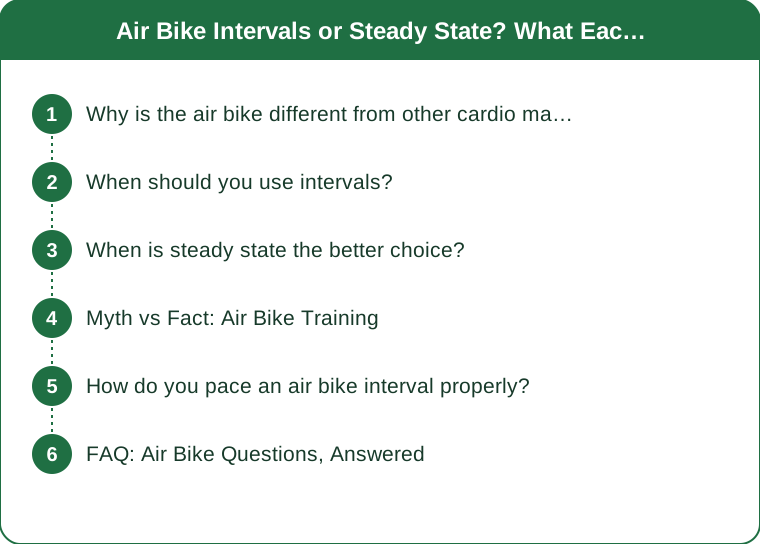
Why is the air bike different from other cardio machines?
Because resistance scales with your own effort, which changes the maths of every workout you do on it.
On a fan bike, air resistance increases roughly with the cube of fan speed. Pedalling twice as fast requires around eight times the power. There is no gear to hide behind and no coasting - the moment you ease off, the resistance drops with you.
Three practical consequences:
- It is self-limiting. You cannot really go too hard for too long; the machine simply slows down.
- The arms are involved. Upper body work raises heart rate faster than legs alone, which is why an air bike interval feels harder than a bike interval at the same perceived leg effort.
- Small pace changes are enormous. Going from 55 to 65 RPM is a much bigger jump in power than it feels like it should be, which is why people blow up 20 seconds into a 60-second effort.
That last point is the one that ruins most air bike sessions. Pacing errors are punished non-linearly here - a 10 percent overshoot in the first interval costs you far more than 10 percent of your remaining capacity.
When should you use intervals?
When the goal is high-intensity capacity, time efficiency, or repeatability of hard efforts.
Three interval structures worth knowing:
Short and sharp (anaerobic power). 20 seconds hard / 40 seconds easy, 8 to 10 rounds. Total 8 to 10 minutes. Target: hitting roughly the same calorie or distance count on the last round as the first. If round 8 is 30 percent below round 1, you went out too hard.
Medium (high-end aerobic). 40 seconds hard / 80 seconds easy, 6 to 8 rounds. Total 12 to 16 minutes. This is the classic conditioning builder and probably the highest-value air bike session for general fitness.
Longer (threshold). 2 minutes hard / 2 minutes easy, 5 rounds. Total 20 minutes. Genuinely difficult, and the honest pacing test - hard here means sustainable-for-two-minutes hard, which is much slower than sprint pace.
Frequency: one to two hard interval sessions per week, maximum, alongside other training. Three or more and you accumulate fatigue faster than adaptation, which manifests as declining numbers on the same session week after week.
Rest matters as much as work. The work-to-rest ratios above are not padding. Short-changing rest turns an interval session into a moderate-intensity grind, which is the least useful thing you can do on this machine.
When is steady state the better choice?
More often than most people think, and it is the quality that is usually missing.
For aerobic base: 20 to 45 minutes at a conversational pace - you could speak in full sentences, breathing elevated but controlled. This builds the aerobic capacity that determines how fast you recover between hard intervals, both within a session and across a week.
This is boring, which is exactly why it gets skipped in favour of intervals that feel more productive. The irony is that a weak aerobic base is the most common reason someone’s interval numbers stop improving.
For active recovery: 10 to 20 minutes very easy, the day after hard training. Blood flow without meaningful fatigue cost. On the air bike this works well precisely because the resistance drops away when you go easy.
For volume without impact: if joints do not tolerate running volume, air bike steady state accumulates aerobic work with essentially no impact loading.
A reasonable weekly split for someone whose main goal is conditioning: one interval session, one to two steady sessions, and any additional easy work as recovery. Roughly 80 percent of total cardio time at easy intensity, 20 percent hard, is a well-established distribution and it holds up here.

Myth vs Fact: Air Bike Training
Myth: If you are not destroyed, it did not count. Fact: The air bike’s reputation for brutality has produced a culture where every session is maximal. That is a good way to build a tolerance for suffering and a poor way to build conditioning. Most weekly volume should be comfortable.
Myth: Calories on the display are a good measure of work. Fact: They are a reasonable relative measure on the same machine for the same person, and close to meaningless as an actual energy figure or as a comparison between machines. Use them to compare round 1 with round 8, not to plan your eating.
Myth: Arms only, or legs only, is a useful variation. Fact: It has a place for injury work-arounds, but the machine’s main advantage is loading both simultaneously. Legs-only removes most of what makes it effective and turns it into a mediocre exercise bike.
Myth: Longer intervals are always harder. Fact: Well-paced two-minute efforts are often more sustainable than badly-paced twenty-second ones. The difficulty comes from your pacing decision far more than from the duration on the clock.
Myth: You should go all-out on every interval to get the benefit. Fact: For anything beyond about 15 seconds, all-out means you fade badly and the average power across the session drops. Repeatability across rounds produces more total work than heroics in round one.
How do you pace an air bike interval properly?
Pacing is the entire skill on this machine, and there is a simple method for finding yours.
The calibration session. Do six rounds of 40 seconds hard / 80 seconds easy. Note the calories or distance for each round. Then look at the shape:
- Round 6 within about 10 percent of round 1: well paced. That is your working intensity.
- Round 6 more than 20 percent below round 1: you started too hard. Drop your opening pace by roughly 10 percent next time.
- Round 6 higher than round 1: you paced too conservatively. Increase the opening pace slightly.
Use RPM as your control, not feel. Feel is unreliable in the first 20 seconds when you are fresh and adrenaline is high. Pick a target RPM and hold it - for many people the difference between a good session and a blow-up is about 5 RPM.
Start the first round deliberately under-cooked. It should feel too easy. On this machine, that instinct is almost always correct and almost never followed.
Track one number per session in a note - total calories, or the round-1 and round-6 figures. Over eight weeks the trend is what tells you the training is working, and it is far more informative than how any single session felt.
FAQ: Air Bike Questions, Answered
How often should I use the air bike?
One hard interval session and one or two easy steady sessions per week suits most people alongside strength training. More hard sessions rarely improve results and commonly stall them.
Why does the air bike feel so much harder than a normal bike?
Arms and legs together recruit more muscle mass, and the resistance rises steeply with speed, so there is no way to coast. Both effects mean heart rate climbs faster at what feels like a comparable leg effort.
Should I set the seat height differently than on a road bike?
Similar principle - a slight bend in the knee at the bottom of the stroke - but many people prefer a fractionally lower seat on an air bike because the arm movement changes trunk position. Adjust for comfort in the handles as well as the legs.
Is the air bike good for fat loss specifically?
It is a time-efficient way to expend energy, which helps, but no machine drives fat loss on its own. Total weekly activity and diet do the work; the bike is a convenient way to add to the activity side without impact.
Can I do air bike intervals on the same day as legs?
You can, but put the strength work first and keep the intervals shorter. Hard bike intervals before squatting will meaningfully reduce the quality of the strength session.
TL;DR:
- Air bike resistance rises with the cube of fan speed, so pacing errors are punished non-linearly
- Intervals for high-end conditioning: 20/40, 40/80, or 2min/2min structures, once or twice weekly
- Steady state for aerobic base and recovery - the quality most people are missing
- Aim for roughly 80 percent easy, 20 percent hard across weekly cardio time
- Judge intervals by repeatability across rounds, and control pace with RPM rather than feel
The air bike is not a machine that rewards enthusiasm. It rewards a decision made before you start about what the session is for, and then holding a pace that feels too easy for the first thirty seconds.
Keep Reading
This article is for general informational and styling purposes only. Fit, sizing, and product availability may vary.