Air Bike Intervals: Why the First 30 Seconds Decide the Whole Workout
Quick Answer: On an air bike, resistance rises with roughly the cube of your effort, so going 20% harder costs far more than 20% more energy. That’s why the first 30 seconds of an interval determine the rest of it. The fix is to start each interval about 10-15% below the pace you think you can hold, and to judge intervals by your last one rather than your first.
Every other cardio machine forgives a fast start. The air bike compounds it. Understanding one piece of physics changes how the entire session feels.
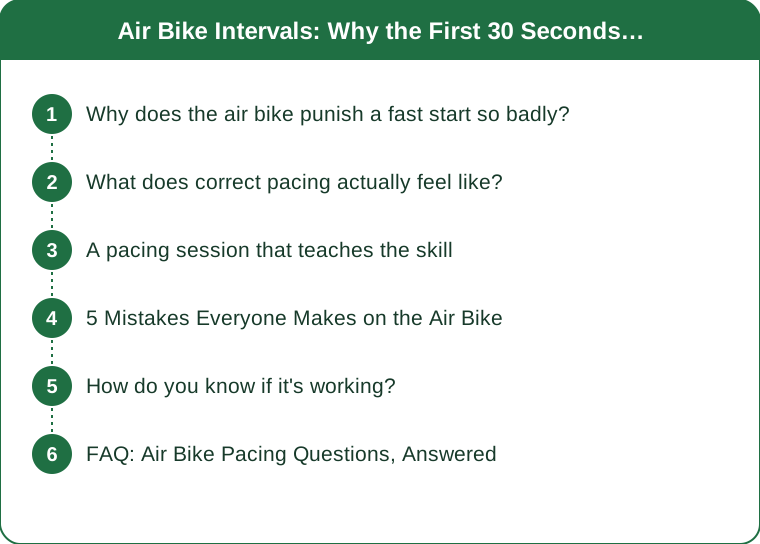
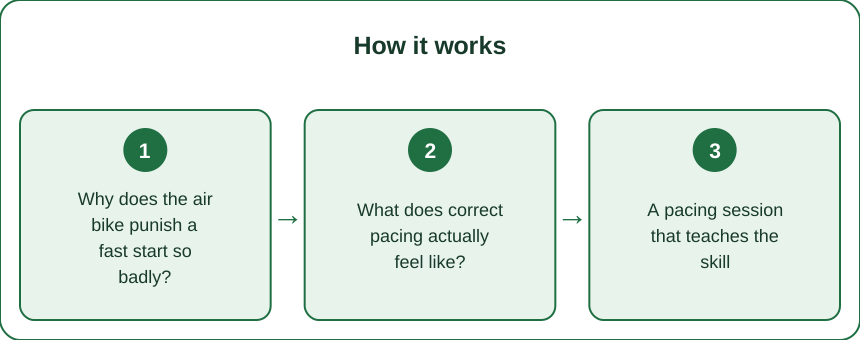
Why does the air bike punish a fast start so badly?
Because a fan creates resistance that scales dramatically with speed.
On a fan bike, air resistance rises roughly with the cube of fan speed. In practical terms: pedalling 25% faster doesn’t cost 25% more effort - it costs closer to double.
This is why the air bike feels uniquely brutal compared to a rower or a treadmill. On a treadmill, going too fast costs you linearly. On a fan bike, it costs you exponentially, and you pay the entire bill within about 40 seconds.
The practical consequences:
- A fast start is enormously expensive and buys you very little distance or calories
- A steady pace produces more total work than the same average achieved by going out hard and fading
- The machine’s calorie counter rewards steadiness, because sustained moderate output beats a spike followed by a collapse
Once you know this, the standard mistake becomes obvious. Almost everyone treats the first 20 seconds as free because it feels easy - and it feels easy because the fan hasn’t spun up yet.
What does correct pacing actually feel like?
Uncomfortably conservative for the first third, and correct by the end. That’s the signature of a well-paced interval.
The 30-second calibration rule: whatever pace you’d naturally start at, back it off by roughly 10-15% for the first half-minute. If you’re using the RPM or watts display, pick a number and hold it rather than chasing a feeling.
By interval type:
- 10-20 second sprints: pacing barely matters, go
- 30-60 second intervals: this is where pacing matters most. Target a pace you could hold for 90 seconds, and finish the interval feeling like you had 10 seconds left
- 2-5 minute intervals: pick a target number on the display in the first 20 seconds and defend it. Do not exceed it early
- 10+ minutes: nasal breathing or being able to speak a short sentence is the correct intensity, regardless of what the display says
The self-check that works: if your last interval is more than about 10% slower than your first, you started too hard. A well-paced session has a flat or very slightly declining profile, not a cliff.
A pacing session that teaches the skill
Do this once and you’ll never guess again. It takes 20 minutes including warm-up.
Warm-up: 5 minutes easy, then 3 x 10 seconds building to moderate.
The set: 6 x 60 seconds, 90 seconds rest.
- Interval 1: deliberately conservative. Note the average number on the display
- Intervals 2-5: hit exactly that number. Not higher. This is the hard part - it will feel too easy in interval 2 and appropriately hard by interval 4
- Interval 6: empty the tank. Note the number
Reading the result:
- If intervals 2-5 held the number and 6 was clearly higher → your pacing target is a little conservative. Add 5% next time
- If you faded during 3, 4, or 5 → interval 1 was too hard. Drop 10% and repeat next week
- If 6 wasn’t higher than the rest → you were at your genuine limit, which is exactly where the target should be
Write the number down. The air bike is one of the few machines where a single calibration number transfers across sessions, and having it removes the guesswork permanently.
5 Mistakes Everyone Makes on the Air Bike
1. Arms doing all the work in the first ten seconds. The upper body fatigues far faster than the legs on a fan bike, and leading with the arms borrows against the whole interval. Drive with the legs; let the arms follow.
2. Chasing calories rather than a pace. The calorie counter updates in a way that rewards spikes, which encourages exactly the fast start this article is about. Watch RPM or watts instead.
3. Not adjusting the seat. Seat too low is the number one cause of the knee ache people blame on the machine. Your knee should have a slight bend at the bottom of the pedal stroke - roughly 25-35 degrees.
4. Comparing your numbers to someone else’s. Fan bike output scales heavily with bodyweight and limb length. Cross-person comparison on an air bike is close to meaningless, and it’s the third mistake that quietly wrecks pacing discipline - people chase a number that was never available to them.
5. Treating the rest period as optional. On a fan bike, incomplete recovery collapses your next interval much faster than on other machines, because the cost of maintaining pace with fatigued legs rises non-linearly. Take the full rest, even if you feel ready early.
How do you know if it’s working?
Not by how destroyed you feel afterward, which is a poor guide on this machine specifically.
Better markers over four to six weeks:
- Same target pace, lower perceived effort. The clearest signal
- Smaller drop-off between first and last interval. A session that used to fade 15% now fades 5%
- Faster recovery between intervals. Heart rate returning further down in the same rest window
- Higher pace at the same drop-off. The one that means real fitness change
Two or three air bike sessions a week is plenty, and one of them should be longer and easier rather than all being intervals. The machine is demanding enough that people routinely overdo the hard sessions and stall.
If you get numbness in the hands, persistent knee pain, or dizziness, stop the session - the first two are usually setup issues and the third is worth a conversation with a doctor. This is general information, not medical advice.
FAQ: Air Bike Pacing Questions, Answered
Should I use damper or resistance settings?
Most air bikes have no adjustable resistance - the fan is the resistance and it self-adjusts to your effort. Some models have a damper; leave it at the manufacturer’s default while you’re learning to pace.
Is the calorie count accurate?
It’s a proprietary estimate, not a measurement, and it differs between brands. Useful as a consistent internal reference on your own machine, useless as an absolute number or a cross-brand comparison.
Why is the air bike so much harder than a spin bike?
Two reasons: the arms are involved, so more muscle mass is working, and the cubed resistance curve means any surge costs disproportionately. It genuinely is harder at the same subjective effort.
How long should rest be between intervals?
For 30-60 second intervals, 1.5 to 2 times the work period is a good default. Shorter rests turn an interval session into a slow, low-quality grind - which has its uses, but isn’t what you planned.
TL;DR:
- Fan resistance scales with roughly the cube of speed, so fast starts cost double what they feel like
- Start each interval 10-15% below your instinct and defend a number on the display
- Do the 6 x 60s calibration session once and write your pacing number down
- A well-paced session fades under 10% from first interval to last
- Judge progress by drop-off and recovery, not by how wrecked you feel
The air bike doesn’t reward courage in the first thirty seconds. It just files the bill and hands it to you at second forty.
Keep Reading
This article is for general informational and styling purposes only. Fit, sizing, and product availability may vary.