Why Your Air Bike Numbers Get Worse in a Hot Room (and What to Do About It)
Quick Answer: Heat degrades air bike performance through two mechanisms at once: your body diverts blood to the skin for cooling, which reduces what’s available to working muscle, and hot air is less dense, so the fan produces less resistance for the same effort. Expect a 5-15% drop in the same workout on a hot day - it’s environmental, not a fitness regression.
You did the same 10-minute effort you did in May, felt like you worked harder, and the display shows worse numbers. Your garage is 32C. That’s the whole story, and there are two separate physics problems inside it.
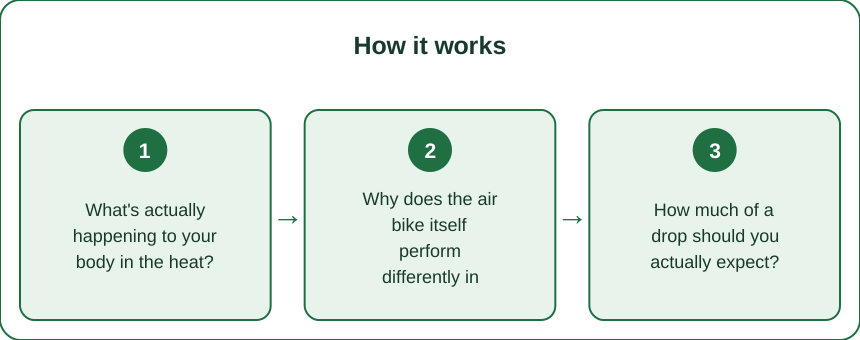
What’s actually happening to your body in the heat?
The dominant factor is cardiovascular strain from thermoregulation. To cool yourself, your body sends a substantial volume of blood to the skin surface, where heat can dissipate. That blood is no longer available to deliver oxygen to working muscle.
The practical consequence is cardiovascular drift: at the same power output, your heart rate climbs progressively higher as the session goes on, because stroke volume drops and heart rate compensates. On a hot day, you can be 15-20 beats per minute higher at the same wattage than you’d be in a cool room.
This is why a hot-weather session feels genuinely harder at a lower output. Your perceived effort is tracking your cardiovascular strain accurately - it just isn’t tracking your power.
Dehydration compounds it. Even mild fluid loss reduces blood plasma volume, which makes the whole problem worse. A session where you lose 2% of body weight in sweat - very achievable on an air bike in a hot garage - measurably impairs endurance performance.
Why does the air bike itself perform differently in heat?
This is the part that surprises people, and it’s specific to fan bikes.
An air bike creates resistance by pushing a fan through air. The resistance you feel depends on air density, and air density falls as temperature rises. Air at 32C is meaningfully less dense than air at 18C.
Less dense air means the fan meets less resistance for the same pedal speed. On an air bike, resistance and output are directly linked - so a less dense environment changes the relationship between your effort and the number on the display.
Humidity contributes too, though in a way most people get backwards: humid air is slightly less dense than dry air at the same temperature, because water vapour is lighter than the nitrogen and oxygen it displaces. The effect is small compared to temperature, but it points the same direction.
The upshot: on a hot, humid day you’re facing a body that’s less able to produce output and a machine that reports differently for the same effort. Two independent effects, stacking.
How much of a drop should you actually expect?
For most people training in an uncooled garage or basement during a hot spell, a 5-15% drop on the same benchmark workout is a reasonable expectation. The high end applies when the room is above 30C, humidity is high, and you’re not well hydrated.
Some rough patterns worth knowing:
- Short sprints (under 30 seconds) are least affected - they’re powered largely by anaerobic systems that heat impacts less.
- Intervals of 1-5 minutes are moderately affected, with the drop growing across repeated rounds as heat accumulates.
- Anything over 10 minutes continuous is most affected, because cardiovascular drift compounds over time.
This means a hot-weather session can look almost normal for the first two intervals and fall apart by the fifth - which reads as a pacing failure but is actually thermal accumulation.
Acclimatisation is real. Consistent training in heat over roughly 7-14 days produces measurable adaptations - increased plasma volume, earlier sweating onset - that recover part of the loss. Someone six weeks into a hot summer will perform better in the same conditions than someone on day two.
Myth vs Fact: Heat and Air Bike Performance
Myth: If your numbers dropped, you lost fitness. Fact: A 10% drop appearing within days of a heatwave is environmental. Real detraining takes weeks and doesn’t reverse the moment the weather cools.
Myth: Sweating more means you burned more. Fact: Sweat rate tracks cooling demand, not energy expenditure. You can sweat dramatically more for less work done.
Myth: Training in heat is a good way to get fitter faster. Fact: Heat acclimatisation is a real adaptation, but training hard in extreme heat mostly reduces the quality of the session. Most people get more from doing the work well in a cooler environment.
Myth: A fan just makes you feel better psychologically. Fact: Air movement genuinely increases evaporative cooling, which directly reduces cardiovascular strain. It’s one of the more effective interventions available.
Myth: Calorie readings are comparable across conditions. Fact: Air bike calorie displays are estimates derived from fan resistance. When air density changes, the underlying relationship changes with it - comparing today’s number to a spring number isn’t comparing like with like.
What actually helps if you can’t cool the room?
Get air moving. A decent floor fan pointed at your torso is the single highest-value intervention. Evaporative cooling needs air movement, and a still hot room prevents your primary cooling mechanism from working. Position it to hit your chest and face, not your back.
Pre-cool. A cold shower or cold drink in the 15-20 minutes before a session lowers your starting core temperature, buying you more working time before thermal strain becomes limiting. Ice water or an ice slushy is more effective than cool water.
Move the session. Early morning is typically the coolest part of the day - often 5-8C cooler than late afternoon in a garage that’s absorbed sun all day. This costs nothing and helps more than most equipment.
Change the workout structure. Shorter work intervals with longer rests preserve output quality far better than long continuous efforts in heat. A 30/30 format survives a hot room much better than a 10-minute time trial.
Hydrate properly, including electrolytes. Aim to drink before you feel thirsty, and add electrolytes for sessions over 45 minutes or in heavy sweating. Plain water in large volumes during heavy sweating isn’t ideal on its own.
Change your benchmark. Track effort-based measures (RPE, heart rate at a given pace) through summer rather than calorie or distance PRs. Comparing to a cool-weather number every session is a guaranteed way to feel like you’re failing at something the thermometer is doing.
Stop for: dizziness, nausea, goosebumps or chills in the heat, confusion, or stopping sweating. These are heat illness signs and warrant stopping and cooling immediately, not pushing through. This is general information, not medical advice.
FAQ: Air Bike Heat Questions, Answered
Will my numbers come back when it cools down?
Yes, typically within days of the temperature dropping. That rapid return is itself the evidence it was environmental rather than fitness loss.
Should I train in the heat on purpose to adapt?
Some deliberate heat exposure produces real acclimatisation over 7-14 days, but it works best with reduced intensity. Doing your hardest sessions in extreme heat mostly reduces training quality.
Does this affect rowing machines and treadmills too?
The physiological half affects everything. The air density half is specific to fan-resistance equipment - air bikes and air rowers. A magnetic-resistance machine won’t show the equipment-side effect.
How do I know if it’s heat or actual detraining?
Do the same test workout on a cool morning. If the numbers return, it was heat. If they don’t, look at sleep, nutrition, and training consistency over the past month.
TL;DR:
- Heat hits twice: your body diverts blood to cooling, and less dense hot air reduces fan resistance
- Expect 5-15% lower numbers on the same session in a hot room
- Longer efforts are affected far more than short sprints
- A floor fan aimed at your torso is the highest-value fix available
- Track effort-based measures through summer instead of chasing cool-weather PRs
The machine didn’t break and neither did your fitness. The room got hot. This is general information, not medical advice.
Keep Reading
This article is for general informational and styling purposes only. Fit, sizing, and product availability may vary.