Why Your Heart Rate Keeps Climbing on the Air Bike
Quick Answer: Heart rate drift on an air bike at a ‘steady’ pace usually means core temperature and dehydration are rising faster than your fitness is adapting — it’s normal to a point, but excessive drift signals you need better pacing or hydration.
You set what feels like the same effort for twenty minutes straight, and somehow your heart rate climbed the whole time. That’s not you getting worse mid-session — it’s a known physiological pattern.

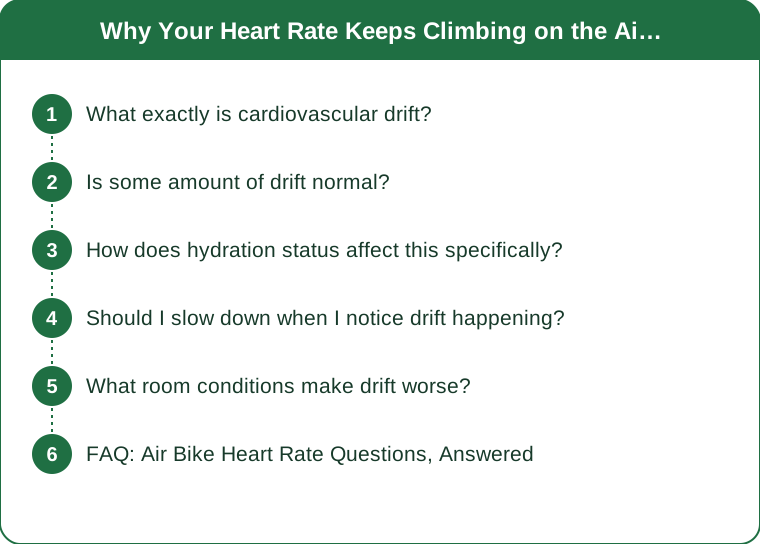
What exactly is cardiovascular drift?
It’s the gradual rise in heart rate during steady-state exercise even when power output or perceived effort stays constant — commonly attributed to rising core body temperature and gradual fluid loss through sweat.
On an air bike specifically, the full-body engagement (arms and legs both driving the fan) tends to produce more heat and drift than a lower-body-only machine like a stationary bike.
Is some amount of drift normal?
Yes — a modest rise of 5-10 beats per minute over a 20-30 minute steady session is common and not a red flag on its own, especially in a warm room.
Sharp, sudden spikes rather than a gradual climb are more worth paying attention to than steady drift.
How does hydration status affect this specifically?
As plasma volume drops from sweat loss, the heart has to beat more times per minute to maintain the same cardiac output — this is one of the most direct, well-documented drivers of drift.
Pre-hydrating before a session and sipping water between intervals measurably blunts this effect in most people.

Should I slow down when I notice drift happening?
If you’re training by heart rate zone, yes — easing the pace slightly to stay in-zone as drift occurs is the standard approach, rather than letting heart rate climb into a harder zone unintentionally.
If you’re training by fixed effort or power output instead, some drift is an expected trade-off, not a mistake.
What room conditions make drift worse?
Heat and poor airflow are the two biggest amplifiers — an air bike in a stuffy garage in summer will show noticeably more drift than the same session in a cool, ventilated room.
A fan pointed at you during air bike sessions isn’t just for comfort — it measurably helps with heat dissipation and can reduce drift.
FAQ: Air Bike Heart Rate Questions, Answered
Does fitness level change how much I drift?
Somewhat — better-trained cardiovascular systems tend to show less drift over the same duration, but heat and hydration still matter regardless of fitness level.
Is drift different from just being out of shape?
Yes — drift happens even in well-conditioned athletes; it’s a temperature and fluid response, not purely a fitness marker.
Should I stop a session if heart rate drifts a lot?
Not necessarily — but if it’s paired with dizziness, excessive fatigue, or nausea, that combination is a stop signal, not drift alone.
TL;DR:
- Heart rate drift at steady effort is mostly driven by rising core temperature and fluid loss
- A gradual 5-10 bpm rise over 20-30 minutes is typically normal
- Hydration and room ventilation measurably reduce drift
- Pair drift with symptoms like dizziness before treating it as a warning sign
This is general information, not medical advice — check with a doctor about cardiovascular symptoms that concern you.
Keep Reading
This article is for general informational and styling purposes only. Fit, sizing, and product availability may vary.